Saturday, November 21, 2009

Tips: ArcGIS Shortcut Keys

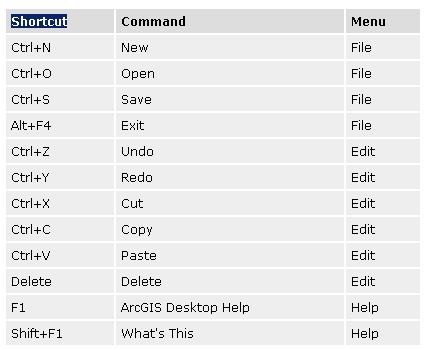
I always knew about shortcut keys in ArcGIS but as I have been transitioning myself away from command line I had almost started to forget that my keyboard even existed anymore. At a recent training session I was reminded that there are some very useful shortcut keys in the ArcGIS environment. To access a list of shortcut keys in ArcGIS go to ArcGIS Desktop Help and search for 'shortcut keys'. Among others there are shortcut keys for: editing in ArcMAP, common tasks in ArcGIS help, common functions in ArcMAP and you can even customize and create your own shortcuts.

Here's a quick teaser for some of the very common shortcuts in ArcMAP:

Problems

GIS in Bangladesh is also experiencing problems on the way to its development. The rapid changes and development of hardwares and softwares pose a serious problem in its upgradation when necessary. There is hardly any co-ordination among organisations using GIS in terms of users' needs, applications, procurement of new softwares and data gathering and exchange of data among the government organisations, research bodies and academic organisations. So far the geographers have demonstrated better skills in analysing GIS outputs in the form of maps. But the local experts at government level are mainly from a non-geography background. Besides, lack of availability of resources, institutional weakness, poor information base, lack of government initiatives, conflicting interests between donor agencies, lack of expertise -- all have constrained its march.

Pioneering role of universities

Almost all the universities of Bangladesh have installed GIS and have been formulating courses on GIS and setting up GIS labs for the purposes of education, training, certificate course, research and services, specially to develop degree-oriented academic curricula at graduate and post-graduate levels and to accomplish collaborative research works with local and foreign organisations and institutions

Present application in Bangladesh

Now GIS is being used in Bangladesh in planning and development purposes both in public and private sectors. At present there are more than 30 installations in the country and about half of them are operational (Rashid and Ali, 1997). Most of the GIS installations here are donor assisted and still operated by foreign experts with limited home personnel. Yet, recently a number of government and private institutions have installed GIS with their own finance and are utilising it for various purposes including resource management, research, policy and decision making etc.

GIS is now being used to generate readily accessible information on the land resources of the country for researchers, extension workers and decision-makers on land and agricultural resources management as well as agricultural development planning. This database constitutes the foundation for a new effort to develop a comprehensive multi scale GIS based Land Resources Information System (LRIS).

GIS based flood forecast models (MIKE-II) have recently been developed in Bangladesh. MIKE-II and its GIS interfaces are suitable for application at the planning, design, implementation and operation levels. The MIKE-II system is a valuable tool for determining flood control and drainage structure operation rules and providing inputs to flood preparedness programmes.

Arsenic researchers of the country are also applying GIS technology for detailed arsenic contamination mapping, modelling and related physical processes of arsenic contamination.
Setting of GIS in Bangladesh


GIS technology made its beginning in Bangladesh in 1991 through ISPAN (Irrigation Support Project for Asia and the Near East) for the FAP-19 (Flood Action Plan-19) Project. The organisation is now named as EGIS (Environment and GIS support projects for water sector planning). At the beginning there were only a few GIS installations, most likely numbering nine, in Bangladesh. Besides, the use of GIS was confined to the government offices only. There was extreme lack of GIS experts and personnel. Most of the GIS installations were run by foreigners. As a result, GIS use in Bangladesh was essentially expensive. LGED (Local Government Engineering Department) was first to use it in its different operations.

What is GIS (Geographic Information System)?


Maps have been used for thousands of years, but it is only within the last few decades that the technology has existed to combine maps with computer graphics and databases to create geographic information systems or GIS. The themes in the above graphic are only a small example of the wide array of information that can view or analyze with a GIS. GIS is used to display and analyze spatial data which are tied to databases. This connection is what gives GIS its power: maps can be drawn from the database and data can be referenced from the maps. When a database is updated, the associated map can be updated as well. GIS databases include a wide variety of information including: geographic, social, political, environmental, and demographic.